
Transforming the Future
Alphabet: The Most Undervalued Tech Conglomerate
Search, cloud, and DeepMind under one roof. While the market debates AI disruption risk, Alphabet quietly compounds across every layer of the stack.
Brian L.
Founder & Principal, Lakespring Investments
May 15, 2026
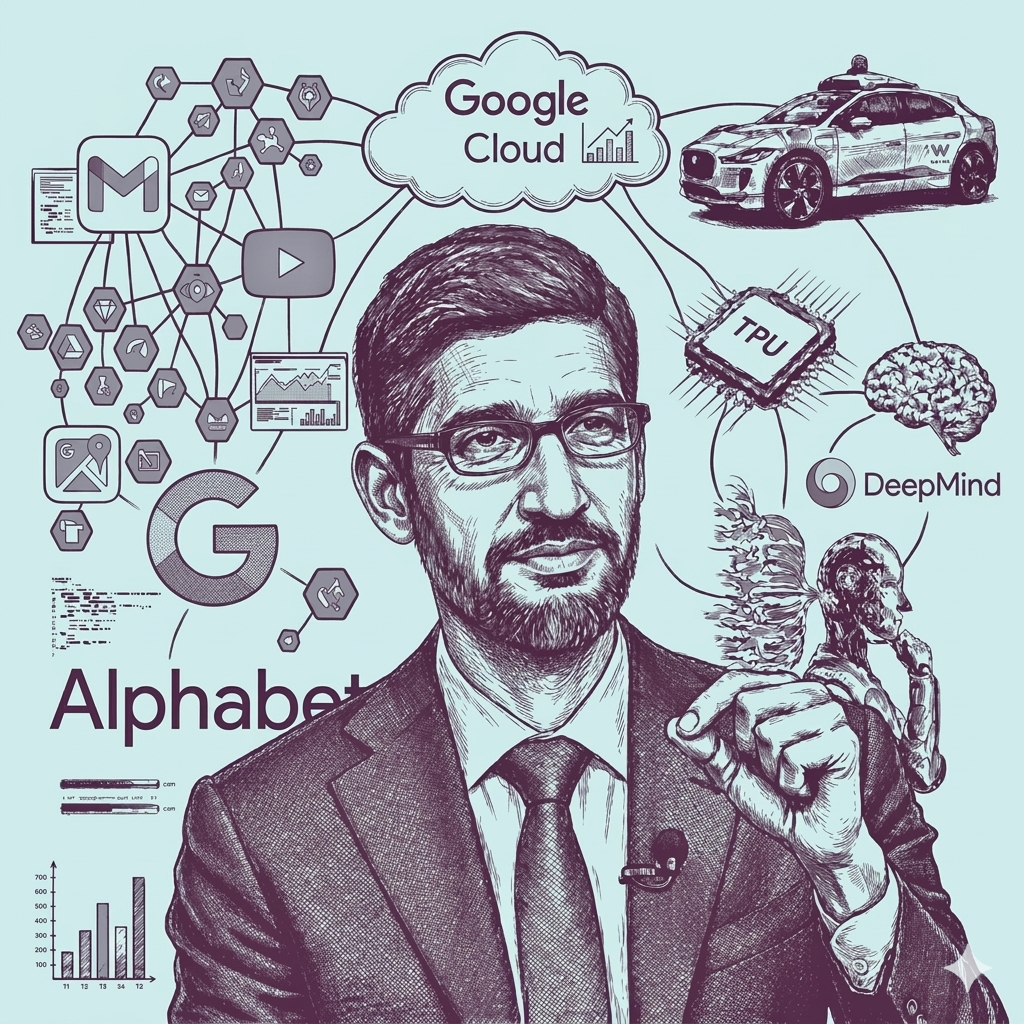
Alphabet is not a search engine company. It is the most diversified technology conglomerate ever assembled — and during a period of unprecedented technological disruption, that diversification is not just an advantage. It is the investment thesis.
There is a question that gets asked a lot in Magnificent Seven discussions: which of these companies has the widest moat? The usual answers are Apple (ecosystem lock-in), Microsoft (enterprise entrenchment), or Nvidia (GPU monopoly). All defensible answers. But the company that almost never gets mentioned in that conversation — and should — is Alphabet.
The reason it gets overlooked is that Alphabet's moat is not built on a single product or a single lock-in mechanism. It is built on something more fundamental and harder to replicate: the broadest and deepest access to human information ever assembled by a single entity. Google Search processes over 8.5 billion queries per day. YouTube serves over 2 billion logged-in users per month and surpassed $60 billion in annual revenue in 2025 across ads and subscriptions. Gmail has over 1.8 billion users. Google Maps is the default navigation layer for the planet. Android runs on over 3 billion active devices. Chrome commands over 65% of the global browser market. Google Workspace is embedded in schools, enterprises, and governments worldwide.
No other company — not Apple, not Microsoft, not Meta, not Nvidia — has this combination. Each of them dominates a vertical. Alphabet dominates the horizontal layer: the infrastructure through which humanity accesses, organises, and interacts with information itself. That is not a product moat. It is an information moat. And in the age of AI, where the value of a model is determined by the quality, breadth, and freshness of the data it can access, that moat is becoming more valuable, not less.
The Data Advantage No One Can Replicate
Every major technology company is building AI. The frontier models from OpenAI, Anthropic, Meta, and Google are converging in raw capability — benchmarks tighten with every release, and the gap between the best model and the fifth-best model is measured in months, not years. If the value of AI were determined solely by the model itself, Alphabet would have no structural advantage.
But the value of AI is not determined by the model. It is determined by what the model can access, what it can learn from, and where it can be deployed. And on all three dimensions, Alphabet has an advantage that is genuinely difficult to articulate without sounding hyperbolic.
Google Search sees the questions humanity asks in real time — not just the answers they find, but the intent behind the queries, the follow-up behaviour, the geographic and demographic patterns of curiosity itself. YouTube sees what the world watches, how long they watch it, what they skip, what they rewatch, and what they search for next. Gmail and Google Workspace see how businesses communicate, how teams collaborate, how decisions are made inside organisations. Google Maps sees where people go, how they get there, and how traffic patterns shift by the hour. Android sees how three billion people use their phones — which apps they open, how often, and in what sequence.
Each of these products is a data flywheel. Each flywheel feeds Gemini — Alphabet's frontier AI model family — with real-time, proprietary training signal that no competitor can access. OpenAI can train on the internet. Google trains on the internet and on the real-time behavioural data of billions of users interacting with the internet through Google's own products. That is a structural difference, and it compounds over time.
What makes this particularly powerful is the transition pathway. Google Search to Gemini is the most seamless AI adoption funnel in existence. Billions of people already use Google Search every day — they do not need to download a new app, create a new account, or change any behaviour. AI Overviews, AI Mode, and the Gemini integrations appear within the same search interface they have used for decades. The user barely notices the shift. But with every query routed through an AI layer, the data enrichment deepens: Google learns not just what people search for, but how they interact with AI-generated answers, what follow-up questions they ask, and where the AI fails. This feedback loop trains Gemini in a way that no standalone AI app can replicate — because no standalone AI app has 8.5 billion daily queries of real-world intent data flowing through it. The result is that the very act of transitioning users to AI keeps them on Google and makes the AI better, which keeps them on Google longer. It is the most elegant adoption flywheel in the history of technology platforms.
AI Overviews reached 1.5 billion monthly users by Q1 2025. The Gemini app itself reached 750 million monthly active users by Q4 2025 and continues to grow rapidly. Gemini models now process over 16 billion tokens per minute via direct API use by enterprise customers — up 60% from the prior quarter. Seventy-five percent of all new code written at Google is now AI-generated.
The data advantage is not just about training better models. It is about deploying those models into products that already have billions of users — products that generate the data that makes the models better, which makes the products more useful, which generates more data. That is the flywheel. And no one else has it at this scale.
The Business Portfolio: More Diversified Than Any Peer
What separates Alphabet from the rest of the Magnificent Seven is the breadth of what it owns. Every other mega-cap tech company can be summarised in a few words: Apple makes devices. Microsoft sells enterprise software. Meta runs social media. Nvidia makes chips.
Alphabet cannot be summarised that way. It operates a portfolio of businesses that would each be among the most valuable companies in their respective sectors if they were independent.
Google Search and Advertising remains the core revenue engine, generating the majority of Alphabet's $400 billion-plus annual revenue. Search revenue grew 17% in Q4 2025 and accelerated to 19% in Q1 2026. The concern that AI would destroy search has been proven wrong — AI is making search better and more engaging, not less.
YouTube surpassed $60 billion in annual revenue in 2025 across advertising and subscriptions. It is the world's largest video platform, the second-largest search engine, the dominant music streaming platform for large portions of the world, and increasingly a live television platform through YouTube TV and the NFL Sunday Ticket deal. YouTube alone would be a top-30 public company by revenue.
Google Cloud ended 2025 with an annual run rate exceeding $70 billion, growing 48% year-over-year in Q4 2025 and accelerating to 63% growth in Q1 2026. Cloud backlog reached $240 billion in Q4 2025 and nearly doubled to over $460 billion in Q1 2026 — a staggering indicator of forward demand. Google Cloud is now the fastest-growing of the three major hyperscalers, driven by enterprise demand for AI infrastructure and Gemini-powered solutions.
Waymo is no longer an experimental bet. In February 2026, Waymo closed a $16 billion funding round — the largest autonomous vehicle fundraise in history — at a $126 billion valuation, a 144% increase from its $45 billion valuation just 16 months prior. The round was three times oversubscribed. Waymo completed 15 million rides in 2025 and surpassed 500,000 fully autonomous rides per week by April 2026, operating across six major U.S. metropolitan areas with plans to enter more than 20 additional cities by the end of 2026. Partnerships with Uber in Austin and Atlanta are extending its reach. While Tesla dominates the autonomous driving narrative, Waymo already has a commercial rideshare operation at scale. That distinction matters.
Google DeepMind is one of the three most important AI research laboratories in the world, alongside OpenAI and Anthropic. DeepMind's contributions — AlphaFold for protein structure prediction, Gemini model development, and breakthroughs in reinforcement learning — have produced Nobel Prize-winning research. Michel Devoret, Google Quantum AI's Chief Scientist, was a 2025 Nobel laureate — the third Googler to receive a Nobel Prize in just two years.
Alphabet's Equity Stakes are an often-overlooked dimension of the investment case. Alphabet holds an approximately 7% stake in SpaceX, acquired in 2015 for roughly $900 million. SpaceX's valuation reached $800 billion in December 2025 secondary trades, implying Alphabet's stake is worth approximately $56 billion — a 6,100% return. With SpaceX and xAI reportedly targeting a combined IPO valuation of $1.75 trillion, Alphabet's stake could appreciate to over $120 billion, representing a potential 13,400% return on a single investment. Additionally, Alphabet holds an approximately 14% stake in Anthropic, one of the leading frontier AI companies, valued at roughly $53 billion.
The SpaceX stake alone — carried on Alphabet's books at a fraction of its implied value — could deliver one of the largest single-quarter asset appreciations in corporate history when SpaceX ultimately goes public. For Lakespring readers, this is particularly relevant: owning Alphabet provides indirect exposure to SpaceX before its IPO — one of only a handful of ways a public market investor can access that position.
The Uncertainty Premium: Why Diversification Matters Now More Than Ever
There is a broader argument for Alphabet that goes beyond any single business line, and it is best understood through the lens of what kind of moment we are living through.
We are in a period of dramatic technological change — the kind that redefines industries, displaces incumbents, and creates entirely new categories of value in ways that are impossible to predict with precision. AI, autonomous systems, quantum computing, and the restructuring of global information infrastructure are all happening simultaneously. History shows that during periods of this magnitude, the companies that survive and compound are not necessarily the ones with the best single product. They are the ones with the financial strength to invest through uncertainty, the diversification to absorb disruption in any one vertical, and the research depth to be on the right side of whatever emerges.
Alphabet checks every box. It has over $95 billion in cash and marketable securities. It generates $130 billion-plus in annual operating income. It is investing $175–$185 billion in CapEx in 2026 alone — not because it has to, but because it can afford to place bets at a scale that most companies cannot contemplate. And those bets are spread across search, cloud, AI models, autonomous vehicles, quantum computing, custom silicon, and strategic equity positions in companies like SpaceX and Anthropic that are themselves reshaping entire industries.
No other company in the world has this combination of financial firepower, business diversification, and research depth deployed simultaneously across this many vectors. During a time when uncertainty is the defining characteristic of the investment landscape, that breadth is not a conglomerate discount. It is a premium.
The Numbers Behind the Narrative
Alphabet's financial performance in 2025 and early 2026 has been exceptional by any standard.
Full-year 2025 revenue exceeded $400 billion for the first time — up from $75 billion when Sundar Pichai took over as CEO in 2015. YouTube and Cloud alone ended 2025 at a combined annual run rate of over $130 billion, nearly double the entirety of Alphabet's revenue a decade ago.
Q1 2026 delivered revenue of $109.9 billion, up 22% year-over-year and significantly ahead of the $106.6 billion consensus estimate. Google Services revenue reached $89.6 billion. Google Cloud revenue hit $20.0 billion, up 63%. Operating income came in at $39.7 billion against a $36.2 billion estimate — a 30% increase, with operating margin expanding two percentage points to 36.1%. Net income surged 81% to $62.58 billion, and earnings per share reached $5.11, up 82%.
The most strategically significant beat was operating income, because it demonstrated that Alphabet can absorb one of the largest corporate capital expenditure programs in history without destroying near-term profitability. With CapEx at $35.7 billion in the quarter — tracking the $175–$185 billion full-year plan — margins expanded rather than compressed. The central concern that had hung over the stock — whether Alphabet could invest at this scale without sacrificing returns — was answered definitively.
Paid subscriptions across Alphabet's consumer services — YouTube Premium, YouTube TV, Google One, and others — reached 350 million, with Gemini Enterprise seeing 40% growth quarter-over-quarter in paid monthly active users.
The market has begun to recognise some of this, but valuation remains modest relative to peers. Alphabet trades at roughly 20 times forward earnings — a lower multiple than Microsoft, Apple, or Nvidia, despite arguably having a broader portfolio of growth vectors, a deeper data moat, and embedded call options (SpaceX, Waymo, Anthropic) that the market has not fully priced.
What Cements the Moat: The Forward Roadmap
The only credible bear case against Alphabet at this point is capital expenditure risk — the concern that $175–$185 billion in annual spending could destroy returns if AI monetisation fails to materialise at scale. It is a fair concern. It is also a concern that applies equally to every hyperscaler: Microsoft, Amazon, and Meta are all making comparable bets. This is not an Alphabet-specific risk. It is the price of admission to the AI race — and the relevant question is not whether the spending is large, but who is best positioned to win the race.
On that question, the forward roadmap is instructive.
Alphabet's custom TPU program — now in its seventh generation with Ironwood, delivering a 10x performance improvement over its predecessor — gives the company a vertically integrated AI stack that no competitor except Nvidia can match. TPU v8 is expected later in 2026. Citizens analyst Andrew Boone projects TPU-related infrastructure revenue will reach $3 billion in 2026 and $25 billion by 2027, turning what was an internal cost centre into an external revenue stream. The AI chip market is running at roughly a $500 billion annual pace; even modest share gains from custom silicon become material at that scale.
The Wiz acquisition — finalized in March 2026, the largest acquisition in Google's history — positions Cloud as the default secure-by-design platform for enterprise AI workloads. As AI deployments move from experimentation to production, security becomes the gating factor for enterprise adoption. Wiz addresses that directly.
Gemini 3.1 continues to push the frontier in reasoning and multimodal understanding. Agentic capabilities — AI that does not just answer questions but performs tasks — are already live in Search through AI Mode, which synthesizes answers, books flights, and compares insurance quotes within the search interface. The trajectory from search engine to AI operating system for everyday life is visible and accelerating.
Quantum computing, while further out, represents the kind of asymmetric long-term bet that only a company with Alphabet's financial position and research depth can afford to make. The Willow chip demonstrated the first verifiable instance of a quantum computer outperforming a classical supercomputer — running an algorithm 13,000 times faster. Practical applications remain years away, but Alphabet is further along the quantum roadmap than any private-sector competitor, and the eventual applications in drug discovery, materials science, cryptography, and optimisation are transformative.
And then there is the Apple partnership — Gemini powering aspects of Siri across Apple's installed base of over 2 billion devices. If that integration deepens, Alphabet's models reach users who have never opened a Google app, on hardware that Alphabet does not need to build or support. That is distribution leverage at a scale that even Google Search cannot match.
The companies that win the AI race will not be the ones that build the best model in a single quarter. They will be the ones that sustain investment at scale, integrate AI into products with billions of existing users, and build the infrastructure — custom silicon, cloud, security, distribution — that makes their AI ecosystem the default. Alphabet is executing on every one of those dimensions simultaneously.
The Investment Thesis
When Elon Musk was asked on Nikhil Kamath's People by WTF podcast which companies outside his own he would consider investing in, his answer was revealing. Despite describing himself as someone who does not buy stocks or maintain a portfolio, Musk pointed to Alphabet without hesitation. His words were precise: he believes Google is going to be "pretty valuable" in the future, and that they have laid "the groundwork for an immense amount of value creation from an AI standpoint." When the person who runs Tesla, SpaceX, xAI, and Neuralink — arguably the most informed technologist on the planet — singles out one company as positioned to create immense value from AI, it is worth paying attention.
The thesis is not complicated. Alphabet is the only company in the world that simultaneously controls the dominant search platform (8.5 billion queries per day), the dominant video platform ($60 billion in annual revenue), a top-three hyperscale cloud ($70 billion run rate, accelerating), the leading commercial autonomous vehicle operation ($126 billion valuation), a top-three frontier AI lab, and equity stakes in SpaceX and Anthropic worth a combined $100+ billion — all wrapped inside a single publicly traded entity generating over $400 billion in annual revenue with 36% operating margins.
The market prices this at 20 times forward earnings. Microsoft trades higher. Apple trades higher. Nvidia trades higher. None of them have this breadth.
During a period of unprecedented technological change — when uncertainty is highest and the future shape of the economy is least predictable — the company with the strongest balance sheet, the widest diversification, the deepest research capabilities, and the most embedded position across AI, cloud, autonomous systems, quantum computing, and strategic venture investments is not the riskiest bet. It is the safest one.
The conglomerate discount the market applies to Alphabet is not a reflection of risk. It is an opportunity.
Disclaimer: This is not financial advice. I'm sharing my personal investment thesis and research process. Do your own due diligence before making any investment decisions.