
Transforming the Future
Eli Lilly: The GLP-1 Platform and What Comes After
Mounjaro and Zepbound rewrote Lilly's growth trajectory. The real thesis is whether the GLP-1 platform extends into cardiovascular, renal, and neurological indications — and whether Lilly's manufacturing scale becomes a moat in its own right.
Brian L.
Founder & Principal, Lakespring Investments
May 5, 2026
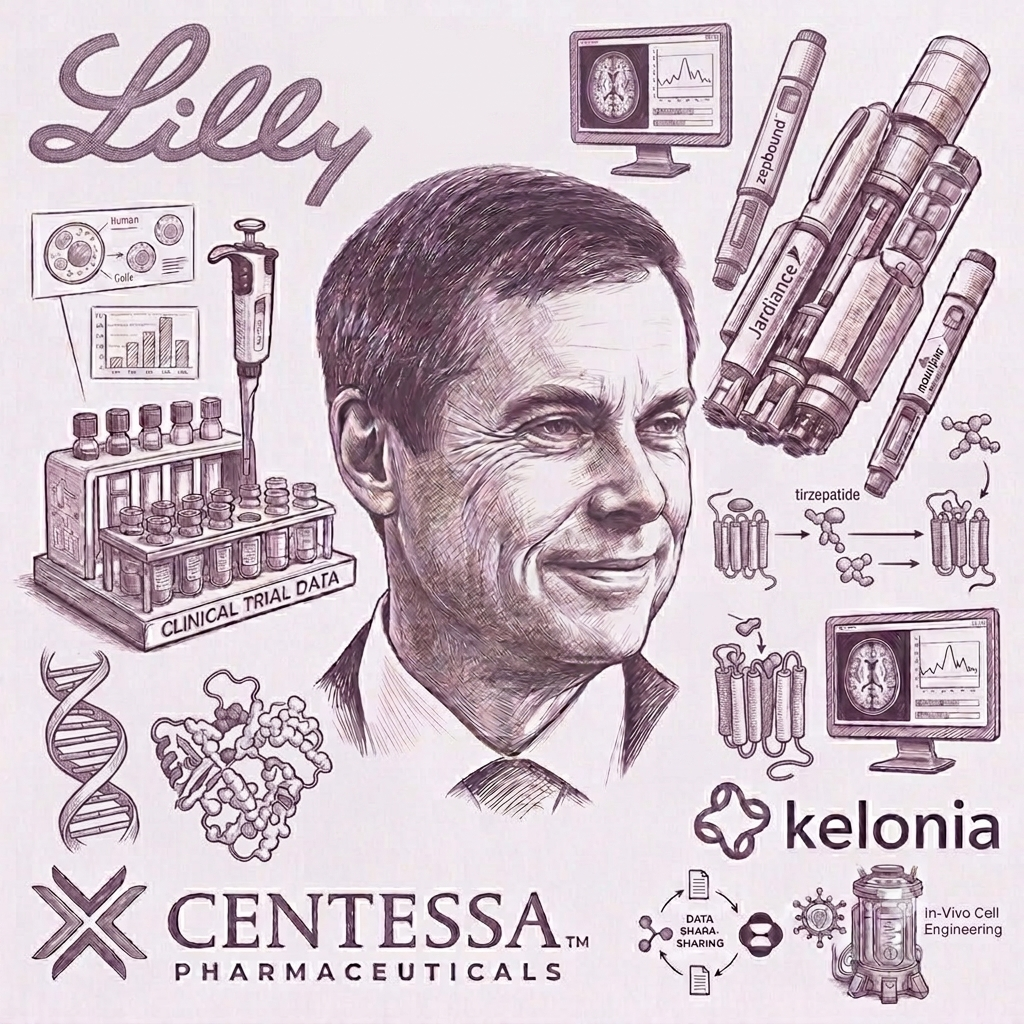
Eli Lilly is not selling a weight loss drug. It is building a therapeutic platform that started with obesity, expanded into diabetes, and is now pushing into cancer, Alzheimer's, heart failure, and sleep apnea — all while using AI to compress the timeline for everything that comes next.
I want to be upfront about something: I am not a pharmaceutical analyst, and my understanding of the biology behind Lilly's drugs is that of an informed generalist, not a domain expert. But the investment thesis that draws me to this company is the same one that underpins every position in the Lakespring portfolio: transformative technology and innovation, leveraging AI, that will drive the world forward for the better.
The positions in the portfolio span chips, autonomous systems, defence infrastructure, and digital commerce — and the through-line is always the same: a company building a platform that compounds, not a product that peaks. The pattern I see in Lilly is familiar: a company using one breakthrough to fund and accelerate the next, whose moat is not just the drug itself but the manufacturing infrastructure, the clinical trial machine, and increasingly the AI capabilities required to sustain the pipeline beyond the current cycle. And critically, there is a dimension here that separates Lilly from the technology positions in the portfolio: the competitive clarity of the AI race. In cloud and AI infrastructure, it is genuinely difficult to say whether Google, Meta, or any of the other hyperscalers will emerge as the biggest beneficiary — all three have the financial resources, the talent, and the infrastructure to win, and the outcome depends on execution decisions that have not been made yet. In pharmaceutical AI drug discovery, Novo Nordisk is not a distant second, but the broader competitive field is far more asymmetric. Lilly is growing revenue at 45% while most major peers — Roche, AstraZeneca, AbbVie — are growing at 7–9%, Merck is flat, and Pfizer is declining. That growth rate differential translates directly into R&D firepower. The AI CapEx race in pharma has a clearer likely winner than the equivalent race among the hyperscalers — and that competitive clarity is part of the thesis. That combination — a compounding business structure with an open competitive lane in AI — is what Lakespring looks for.
The GLP-1 Platform: More Than a Weight Loss Drug
The story starts with tirzepatide — marketed as Mounjaro for type 2 diabetes and Zepbound for obesity. Tirzepatide is what pharmacologists call a dual GLP-1/GIP receptor agonist — in plain terms, it mimics two gut hormones simultaneously (GLP-1 and GIP) that regulate appetite, blood sugar, and metabolism, telling your brain you are full and telling your body to burn fat more efficiently. The clinical results have been extraordinary: patients in trials lost 20–25% of body weight on average, substantially outperforming Novo Nordisk's semaglutide (Ozempic/Wegovy), which targets only one of those two hormones. Mounjaro generated $8.7 billion in revenue in Q1 2026 alone, up 125% year-over-year. Zepbound added another $4.1 billion, up 79%. Combined, the two drugs produced $12.8 billion in a single quarter — adding $6.7 billion of incremental revenue compared to the same quarter a year earlier.
Those numbers are remarkable on their own. What makes the thesis genuinely compelling is that tirzepatide is not the end of the pipeline. It is the beginning.
Foundayo (orforglipron), Lilly's oral GLP-1 small molecule, received FDA approval in April 2026 — making it the first oral GLP-1 pill for obesity. This is a structural inflection point for the entire market. Injectable drugs, no matter how effective, have an inherent adoption ceiling: many patients simply will not self-inject. An oral daily pill removes that barrier entirely and expands the addressable population to hundreds of millions of people who would take a pill but would never pick up a syringe. Novo Nordisk received FDA approval for oral Wegovy in December 2025, so the oral GLP-1 race is now a two-horse contest — but Lilly's pipeline behind Foundayo is deeper.
Retatrutide is the next generation. Where tirzepatide activates two hormonal pathways, retatrutide activates three — GLP-1, GIP, and glucagon — adding a third mechanism that accelerates fat burning directly. It is currently in Phase 3 trials across obesity, type 2 diabetes, and osteoarthritis. Early-stage data showed weight loss exceeding 24% at the highest doses, potentially making it the most powerful weight management compound ever tested. If approved, retatrutide would give Lilly three distinct GLP-1 platform drugs (injectable tirzepatide, oral orforglipron, and triple-agonist retatrutide), each targeting different patient profiles and clinical needs.
This is the platform strategy that most investors miss. Lilly is not selling a single drug into a single indication. It is building a therapeutic category — and then expanding that category into every adjacent condition where the same biological mechanism has clinical relevance. Tirzepatide is already in trials or approved for obesity, type 2 diabetes, obstructive sleep apnea, heart failure with preserved ejection fraction, and MASH (metabolic-associated steatohepatitis — a form of fatty liver disease that affects roughly 25% of adults globally and currently has very few approved treatments). Zepbound combined with Taltz is showing positive Phase 3 results in psoriatic arthritis with co-existing obesity. Each new indication is a new total addressable market layered on top of the original obesity and diabetes base — without requiring a new molecule.
The TAM Is Staggering — and We Are in the First Inning
The numbers on this market are difficult to overstate.
Approximately two in five adults in the United States live with obesity. Roughly one billion people worldwide meet the clinical definition. Wall Street consensus projects the global weight-loss drug market will reach $150 billion annually by 2030. Analysts at Truist project that Lilly's obesity franchise alone could reach $101 billion in peak annual revenue. For context, that single franchise would be larger than the total revenue of every pharmaceutical company on Earth except Lilly itself and perhaps Novo Nordisk.
And this is before oral formulations meaningfully penetrate the market. Foundayo launched in April 2026 — the adoption curve has barely started. The transition from injectable to oral GLP-1 therapy will likely mirror the transition from injectable to oral diabetes drugs in previous decades: a massive expansion of the patient population as the convenience barrier disappears. The patients who will take a daily pill but would never self-inject represent the largest untapped segment of the obesity market, and Lilly is now positioned to capture them.
The incretin market in the U.S. grew total prescriptions by over 80% in Q1 2026, with Zepbound gaining share at an even faster pace. Self-pay accounted for approximately 45% of total Zepbound prescriptions and 55% of new prescriptions — meaning nearly half of the demand is coming from patients paying out of pocket, not waiting for insurance coverage. That is a demand signal that does not depend on payer negotiations or government reimbursement timelines. It is pure consumer pull.
Beyond Obesity: The Oncology Pivot
The bull case for Lilly extends well beyond GLP-1 drugs — and the company is making that case with its capital allocation.
In the first half of 2026 alone, Lilly announced agreements to acquire Kelonia Therapeutics (up to $7 billion), Centessa Pharmaceuticals (up to $7.8 billion), Orna Therapeutics, and Ajax Therapeutics. The Kelonia acquisition is the most strategically significant: Kelonia has developed a proprietary in vivo CAR-T platform — CAR-T stands for Chimeric Antigen Receptor T-cell therapy, which is essentially a technique for reprogramming a patient's own immune cells to recognise and destroy cancer. What makes Kelonia's approach different is that it does this inside the body using a single intravenous infusion — no cell harvesting, no laboratory engineering, no preconditioning. Jacob Van Naarden, president of Lilly Oncology, called Kelonia's data "nothing short of remarkable." RBC Capital Markets analyst Trung Huynh described in vivo CAR-T as the "holy grail" of cell therapy.
Current approved CAR-T treatments — like Johnson & Johnson's Carvykti ($1.89 billion in 2025 sales) — require extracting a patient's T-cells, shipping them to a specialised lab, genetically engineering them over several weeks, and then reinfusing them. It is logistically intensive, extremely expensive, and limited to academic medical centres that can support the process. Kelonia's approach collapses that entire chain into a single infusion administered in any oncology clinic. If it works at scale, it does not just compete with existing CAR-T — it makes existing CAR-T obsolete.
This is not Lilly's only oncology play. Verzenio (abemaciclib) is a breast cancer treatment that works by blocking proteins called CDK4/6 that drive tumour cell growth. Retevmo (selpercatinib) targets a specific genetic mutation called RET that drives certain lung cancers — its Phase 3 adjuvant data is being presented in the Plenary Session at ASCO 2026, the most prestigious slot at oncology's most important annual conference. Jaypirca (pirtobrutinib) treats blood cancers by inhibiting a protein called BTK that malignant B-cells depend on for survival, and is showing positive Phase 3 results in relapsed chronic lymphocytic leukaemia. Key Products revenue in Immunology, Oncology, and Neuroscience grew 160% in Q1 2026 compared to Q1 2025 — a growth rate that would be headline-making for any company, but gets buried under the GLP-1 narrative at Lilly.
The oncology expansion is not a diversification play for its own sake. It is a deliberate strategy to build a second growth engine that can sustain the company beyond the GLP-1 cycle — and to do it by acquiring technologies that are early enough to have decades of patent protection ahead of them. Van Naarden stated it plainly: "We're going to be a player in hematology." The acquisitions in 2026 suggest the ambition extends well beyond hematology into solid tumours, cell therapy, and next-generation biologics.
AI as the Pipeline Accelerator
Every pharmaceutical company faces the same existential risk: the patent cliff. When a blockbuster drug's patent expires — typically 10–15 years after approval — generic manufacturers can produce identical versions at a fraction of the price, and revenue from that drug collapses, often by 80% or more within a few years. The only defence is to have the next generation of drugs ready before the current generation loses exclusivity. Historically, that pipeline cycle takes 10–15 years from discovery to approval, at a cost of $1–2 billion per approved drug. Most candidates fail.
Lilly's approach to this problem is AI — and they are further along than the market recognises.
In March 2026, Lilly signed a $2.75 billion research and licensing agreement with Insilico Medicine — one of the largest AI-driven drug discovery deals in the history of the pharmaceutical industry. The deal gives Lilly exclusive worldwide rights to develop, manufacture, and commercialise a portfolio of novel oral therapeutics discovered using Insilico's generative AI platform (Pharma.AI). The collaboration builds on a relationship that began in 2023 and expanded in November 2025 into joint compound discovery.
The efficiency gains are material. Insilico's platform has demonstrated the ability to compress preclinical timelines from the industry standard of 3–5 years to under 18 months. At least two Insilico-derived candidates have already moved into clinical testing. Lilly appointed a Chief AI Officer in 2024, signalling that AI integration is not a side project but a strategic priority embedded across the R&D organisation.
The logic is straightforward: if AI can cut discovery timelines in half and reduce the failure rate even modestly, the return on R&D investment improves dramatically — and the patent cliff becomes manageable rather than existential. For a company generating $65 billion in annual revenue, projecting $82–$85 billion in 2026, and printing cash at a rate that funds $20+ billion in acquisitions while still returning $4 billion to shareholders in a single quarter, the ability to reinvest that cash flow into AI-accelerated discovery creates a compounding loop between current revenue and future pipeline that most pharmaceutical companies simply cannot afford to match. Novo Nordisk remains a formidable rival with deep resources and decades of metabolic expertise, but the growth rate differential across the rest of the field is stark: Lilly grew revenue 45% in FY2025 while Roche grew 7%, AstraZeneca grew 9%, Merck grew 1%, and Pfizer declined 2%. The race is not about who has the best model — it is about who can afford to deploy AI at scale across the entire discovery-to-approval pipeline, and Lilly's growth rate gives it financial ammunition that only Novo Nordisk can plausibly match.
The Manufacturing Moat
There is a dimension of Lilly's competitive position that rarely appears in analyst reports but is critically important: manufacturing capacity.
GLP-1 drugs are biologically complex peptides — short chains of amino acids that mimic natural hormones — and they require specialised production facilities that are fundamentally different from a typical pharmaceutical plant. The production process involves fermentation (growing the molecules in living cells), purification (isolating them to pharmaceutical-grade purity), fill-finish (packaging them into injectable pens or tablets), and cold-chain logistics at a scale that takes years to build and billions of dollars to fund. Lilly has invested over $25 billion in manufacturing capacity expansion — including new facilities in Indiana, North Carolina, Ireland, and Germany — specifically to meet the demand curve for its incretin portfolio.
This is a physical moat. Competitors cannot replicate it quickly, even with unlimited capital, because the regulatory approval process for new manufacturing facilities takes 2–3 years after construction is complete. Novo Nordisk has its own manufacturing infrastructure, but smaller GLP-1 entrants — and there are several in clinical trials — face a multi-year lag between achieving drug approval and achieving the manufacturing scale needed to compete commercially.
The parallel to Amazon's logistics network is instructive. Both companies invested billions in physical infrastructure before the demand fully materialised, building capacity that creates a structural cost and speed advantage once the market scales. Lilly's manufacturing investment is not a cost — it is a barrier to entry.
The Competitive Landscape: Novo Nordisk and the Field
Intellectual honesty requires acknowledging that Lilly does not operate in a vacuum. Novo Nordisk — with semaglutide (Ozempic, Wegovy) and its own oral formulation — is a formidable competitor with a first-mover advantage in the GLP-1 market, strong brand recognition, and decades of experience in diabetes care.
The competitive dynamics, however, favour Lilly's pipeline depth. Tirzepatide's dual-agonist mechanism has demonstrated superior weight loss and glycaemic control compared to semaglutide in head-to-head trials. Retatrutide's triple-agonist mechanism, if Phase 3 data holds, could represent another step-change in efficacy. Foundayo gives Lilly an oral entry that competes directly with oral Wegovy. And the oncology, neuroscience, and immunology expansions give Lilly growth vectors that Novo Nordisk — a more narrowly focused company — does not have.
Beyond Novo, Roche, AstraZeneca, and several mid-cap biotechs are developing their own GLP-1 and incretin-based compounds. The market is large enough to support multiple winners, but Lilly's combination of clinical data, manufacturing capacity, oral and injectable platforms, and next-generation pipeline (retatrutide) positions it to maintain or expand its market share even as competition intensifies. The risk is not that competitors will enter — they will. The risk is that Lilly's pipeline stalls. The Kelonia, Centessa, Orna, Ajax, and Insilico deals suggest management is acutely aware of that risk and is investing aggressively to mitigate it.
The Numbers
Eli Lilly's financial trajectory is unlike anything in the pharmaceutical industry.
Full-year 2025 revenue reached $65.2 billion, up 45% year-over-year. Q1 2026 revenue was $19.8 billion, up 56%, significantly ahead of expectations. Non-GAAP EPS was $8.55, up from $3.34 in Q1 2025 — a 156% increase. Management raised full-year 2026 guidance by $2 billion at both ends to $82–$85 billion in revenue and $35.50–$37.00 in non-GAAP EPS. The midpoint represents 28% growth on a $65 billion base — a growth rate that most technology companies would envy, delivered by a pharmaceutical company.
Mounjaro and Zepbound combined for $12.8 billion in Q1 2026 revenue, adding $6.7 billion of incremental growth versus Q1 2025. International Mounjaro held above 53% market share outside the U.S. and above 60% in Brazil and Korea. The revenue trajectory is not decelerating — it is accelerating, driven by geographic expansion, new indications, and the launch of Foundayo.
The operating leverage story is equally important. Revenue is compounding faster than costs, and margins are expanding. Lilly distributed $1.5 billion in dividends and repurchased $2.4 billion in shares in Q1 2026 alone, demonstrating that the growth is not consuming all available cash flow — there is room to return capital while simultaneously funding $20+ billion in acquisitions and expanding manufacturing capacity.
The Investment Thesis
The thesis on Eli Lilly is that the market is pricing a weight loss drug company when it should be pricing a therapeutic platform company — and the difference between those two valuations is significant.
A weight loss drug company has a single revenue driver, faces patent cliff risk, and competes on efficacy within a narrow indication. A therapeutic platform company uses one breakthrough to fund the next, expands the same biological mechanism across multiple conditions and patient populations, invests in AI to compress discovery timelines, acquires next-generation technologies (in vivo CAR-T, circular RNA, AI drug discovery) before competitors, and builds manufacturing infrastructure that functions as a physical barrier to entry.
Lilly is the latter. The GLP-1 franchise — Mounjaro, Zepbound, Foundayo, and retatrutide — is the engine that generates the cash flow. But the cash flow is being deployed into oncology (Kelonia, Centessa, Verzenio, Retevmo), neuroscience (Kisunla for Alzheimer's), immunology (Ebglyss, Omvoh, Taltz), and AI-powered drug discovery (Insilico) simultaneously. The obesity market alone is projected to reach $150 billion by 2030, with Lilly's franchise projected at $101 billion in peak revenue. But the investment case does not depend solely on obesity — it depends on the platform's ability to compound across therapeutic areas, using the manufacturing moat and AI-accelerated pipeline to stay ahead of both the patent cycle and the competition.
Lilly is not cheap. At roughly 40–45 times forward earnings, the market is pricing in substantial growth. The question is whether the growth justifies the multiple — and with revenue accelerating at 56% year-over-year on a $65 billion base, a $150 billion TAM in obesity alone, an oncology expansion that could rival the GLP-1 franchise over a decade, and an AI drug discovery infrastructure that compresses the timeline for everything that comes next, the answer is that the growth may be underpriced rather than overpriced.
In a market where most pharmaceutical companies are managing decline, Lilly is compounding. That is rare enough to deserve a premium.
Disclaimer: This is not financial advice. I'm sharing my personal investment thesis and research process. Do your own due diligence before making any investment decisions.