
Transforming the Future
The Musk Industrial Complex: Valuing the Vision of Abundance
Wall Street still treats Tesla like a car company. But the empire being assembled across vehicles, robots, energy, connectivity, compute, and orbit has no real precedent in the history of capital markets.
Brian L.
Founder & Principal, Lakespring Investments
June 6, 2026
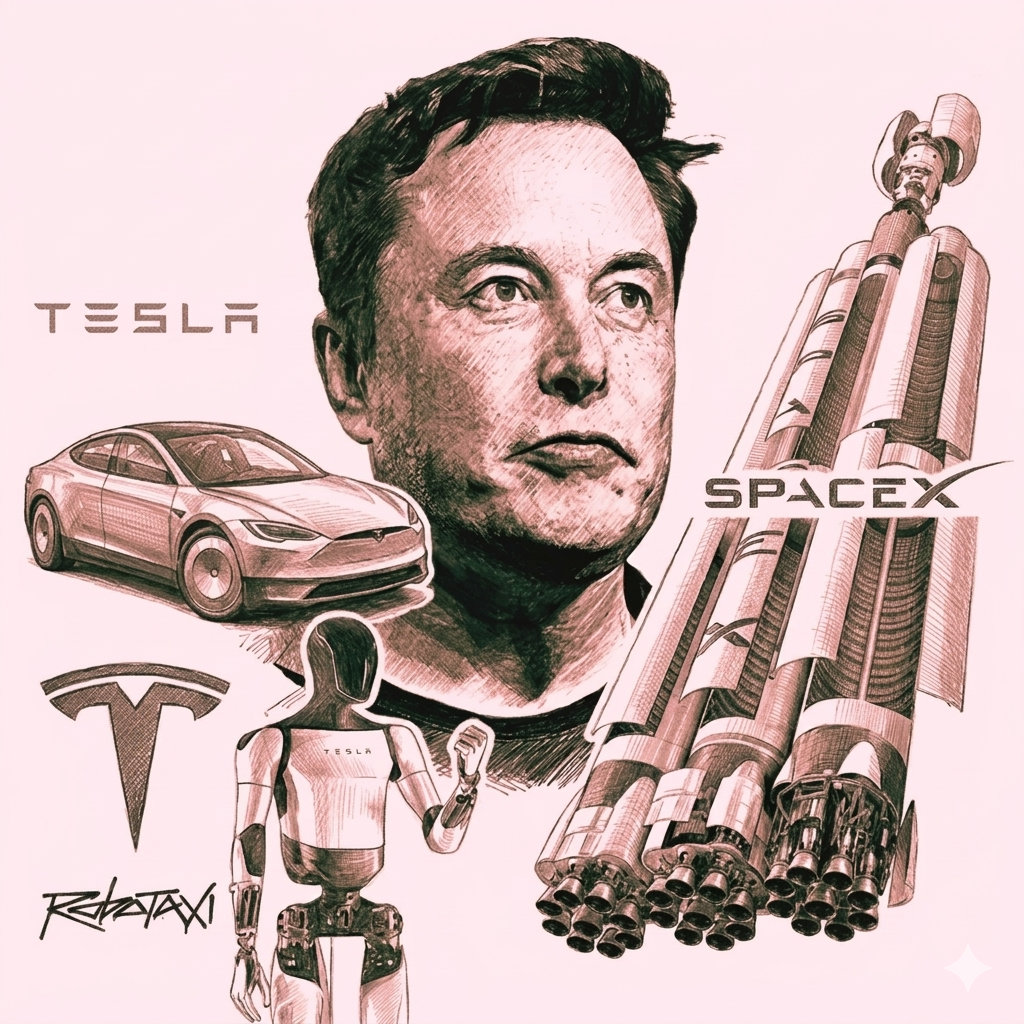
Wall Street still treats Tesla like a car company.
Analysts compare it to Ford and GM. They model automotive revenue growing at some percentage and call it a day. But there's a deeper misreading happening now that is arguably more consequential: investors are treating Elon Musk's companies as separate entities. They're not. They are converging — operationally, financially, and strategically — into something that has no real precedent in the history of capital markets. Musk himself said it in November 2025:
"My companies are, surprisingly in some ways, trending towards convergence."
With SpaceX pricing its IPO at $135 per share and debuting on Nasdaq under the ticker SPCX on June 12th — in what would be the largest public offering in history at a $1.75 trillion valuation — this is the right moment to zoom out and look at the whole picture. Not Tesla. Not SpaceX. The empire.
Tesla: The Foundation Is Being Rebuilt From the Floor Up
Tesla delivered 1.6 million vehicles in 2025, with full-year automotive revenue of $69.5 billion. Deliveries fell 8.6% for the second consecutive year. Brand damage from Musk's political activity created real consumer headwinds in Europe and the U.S., and BYD surpassed Tesla as the global EV volume leader. These are legitimate data points, and any honest analysis has to include them.
But here is what matters more: Tesla is no longer building toward an automotive future. The company is actively dismantling its automotive past to fund something far larger.
The Signal Is in the Factory Floor
In January 2026, Musk announced during Tesla's Q4 earnings call that the company would discontinue the Model S and Model X — its longest-running vehicles — by Q2 2026. Production wound down in April. The Fremont factory floor that built those vehicles for fourteen years is not going idle. It is being converted into a large-scale production base for Optimus humanoid robots and Cybercab autonomous taxis, with a long-term target of up to one million humanoid robots annually from the first-generation line alone. A second-generation line at Gigafactory Texas is being designed for ten million robots per year.
This is not a product cancellation. It is a declaration of priorities. When a company walks away from $100,000 vehicles with established demand because the factory floor is worth more pointed at something else, that is a statement about where the real value lies. Musk put it plainly on the earnings call:
"We're really moving into a future that is based on autonomy. Vehicles are no longer Tesla's core product."
That is a remarkable sentence for the CEO of a company that built its entire foundation on vehicles. And it deserves to be taken seriously.
The Robotaxi service launched commercially in Austin in June 2025. By January 2026, Tesla had begun removing safety monitors from operating vehicles. By June 4, 2026, the service expanded to cover the entire Austin metropolitan area — suburbs, major highways, and Austin-Bergstrom International Airport. Dallas and Houston went live in April. Tesla is targeting unsupervised Full Self-Driving in roughly a dozen U.S. states by year end.
Musk has been direct that Robotaxi revenue will not be material in 2026 — meaningful contribution is a 2027 story. But the unit economics, if they hold at scale, are structurally unlike anything in automotive. A Cybercab purpose-built for autonomous deployment costs an estimated $40,000–$45,000 to manufacture. Each vehicle operating continuously at commercial utilization could generate $67,000 in net profit in year one, scaling toward $94,000 by year five. A vehicle earning ride revenue sixteen hours a day looks nothing like a one-time car sale. It looks like a software business running on wheels.
The cash generated from Tesla's automotive operations — still a real, profitable business at $69.5 billion in revenue — is precisely what funds the high capital expenditure required to get there. Tesla guided $25 billion in capex for 2026, the majority directed at AI training compute, Dojo expansion, and Robotaxi fleet infrastructure. The EV business is not the destination. It is the engine funding the transition.
What does Robotaxi mean for valuation? Waymo, Alphabet's autonomous vehicle unit, carries an estimated $200 billion valuation today despite minimal revenue. Tesla has more data, a lower-cost vehicle purpose-built for the network, and an existing fleet of millions of owner vehicles that could be leased into the network at near-zero acquisition cost. A Robotaxi network at scale does not get valued like an automaker. It gets valued like a transportation platform — and transportation platforms carry software multiples.
The Semiconductor Stack: Terafab and the ASML Chokepoint
The Terafab announcement in March 2026 — a joint initiative between Tesla, SpaceX, and xAI — is the most underappreciated piece of the convergence story. It is not a chip factory. It is an attempt to own the entire semiconductor supply chain from design through fabrication, and in doing so, to route around the single most critical bottleneck in global AI infrastructure.
That bottleneck is ASML. The Dutch company holds a near-absolute monopoly on the extreme ultraviolet lithography machines required to manufacture the most advanced semiconductors. Every leading chip — Nvidia's H100, Apple's A-series, TSMC's advanced nodes — depends on ASML equipment. No ASML machines, no advanced chips. The waiting list for EUV systems runs years long, and export controls have made them effectively unavailable to China and increasingly subject to geopolitical disruption.
Terafab's approach is to bypass this constraint rather than fight it. Rather than competing on silicon miniaturization — the 2nm and 3nm race that requires ASML's most advanced machinery — Terafab is betting on Gallium Nitride (GaN) chiplets and advanced 3D packaging. GaN operates under fundamentally different physical rules than silicon: it handles higher voltages, temperatures, and frequencies, and can be manufactured on more mature nodes using Deep Ultraviolet lithography equipment that is widely available and not subject to the same supply constraints. The performance gains come from packaging engineering — stitching specialized chiplets together using Intel's Foveros advanced packaging technology — rather than from shrinking transistors.
The full buildout is estimated at up to $119 billion, with Phase 1 alone at $55 billion. The goal is to produce one terawatt of AI compute annually — approximately 50 times current global chip output. That is not incremental. If achievable, it represents the same vertical integration logic that Tesla applied to battery cells and motors, now applied to the fundamental input of the entire AI economy.
Whether Terafab succeeds is genuinely uncertain. The timeline extends to 2030 and the material science challenges are real. But the strategic intent is unambiguous: Musk is attempting to build the rails, not just run trains on them.
SpaceX: The Half That Changes Everything
Here is the number that reframes the entire conversation.
SpaceX generated $18.7 billion in total revenue in 2025. Starlink — the satellite connectivity business — contributed $11.4 billion of that, growing 48% year-over-year and generating $4.4 billion in operating profit. The rocket launch and space operations business added $4.1 billion. The xAI segment, acquired in February 2026 for $250 billion, contributed $3.2 billion in revenue but carried significant losses while Grok's development scaled.
Starlink is the most important infrastructure business most investors aren't modeling. By February 2026, it had surpassed 10 million active customers across 160 countries. The subscriber base roughly doubled in 2025 alone. Each marginal satellite added to the constellation increases coverage and capacity at near-zero incremental customer acquisition cost. In May 2026, SpaceX began raising Starlink plan prices — the first signal of a deliberate shift from volume growth toward margin optimization on a network that is now effectively global.
SpaceX's IPO on June 12th, targeting $135 per share and raising $75 billion, would surpass Saudi Aramco's 2019 offering as the largest public listing in history. Tesla, the publicly traded half of the empire, sits at roughly a $1.66 trillion market cap. Stitch them together and you have a single entity worth approximately $3.4 trillion — the largest company ever assembled under one operational umbrella.
One of the more remarkable developments ahead of the IPO is what SpaceX did with its Colossus 1 data center in Memphis, Tennessee. The facility — housing over 220,000 Nvidia GPUs including H100, H200, and GB200 chips, drawing more than 300 megawatts of power — was originally built to train Grok. SpaceX's S-1 filing indicates Colossus was running at approximately 11% model flop utilization. Rather than let that infrastructure sit underutilized, SpaceX leased the entire cluster to Anthropic under a six-month arrangement at a reported $1.25 billion per month — with an extension to Colossus 2 planned, and total potential payments approaching $15 billion through May 2029.
This deal does several things simultaneously. It transforms underutilized infrastructure into a reliable near-term revenue stream ahead of the IPO. It signals that SpaceX's AI segment — even while incurring heavy losses funding Colossus 2 and orbital compute ambitions — can generate significant infrastructure rental income. And Anthropic has publicly expressed interest in future orbital compute partnerships, making it a potential anchor tenant for the very business SpaceX is pitching to IPO investors.
SpaceXAI is not retreating from AI. It is repositioning as infrastructure — building and renting the rails rather than competing on the frontier model layer where the talent and capital requirements are brutal.
The Orbital Compute Thesis: Unlimited Energy, Zero Real Estate
The most speculative — and potentially most consequential — layer of this thesis is orbital AI data centers. And to understand why it is plausible rather than absurd, you have to start with a simple physical constraint that is increasingly shaping every decision in the AI economy.
AI data centers require enormous amounts of power. The hyperscalers — Microsoft, Meta, Amazon, Google — are collectively committing approximately $725 billion in capital expenditure in 2026, almost entirely on data centers, chips, and GPUs. Power grids in the critical data center corridors — Northern Virginia, the Nordics, Singapore — are saturated. Permitting new facilities takes years. Water rights for cooling are increasingly contested. The buildout of terrestrial AI infrastructure is running directly into the physical limits of the electrical grid and the political limits of land use.
Space has neither of these constraints. A satellite in geosynchronous orbit receives solar energy continuously, without the intermittency of terrestrial solar, without competing for land, without requiring cooling water, and without being subject to national permiting regimes. The energy available from the sun is, for any practical horizon, unlimited. SpaceX's S-1 states the company's goal directly: "Our goal over time is to launch 100 gigawatts of compute to space each year." For context, 100 gigawatts of continuously operating compute would represent roughly one-fifth of total annual U.S. electricity production — delivered from orbit, powered entirely by solar energy, outside the constraints that are choking terrestrial expansion.
SpaceX formally filed plans with the FCC in January 2026 for a constellation of up to one million computing satellites. Google and SpaceX are in active discussions to co-develop orbital AI infrastructure. NVIDIA announced the Space-1 Vera Rubin Module at GTC in March 2026 — a dedicated space-rated GPU platform — signaling that the chip ecosystem is preparing for an orbital compute market.
The economic case does not work yet at scale. Orbital compute currently costs roughly four times more per unit than terrestrial alternatives. The bull case rests on Starship: if SpaceX achieves sub-$100 per kilogram launch costs — down from $1,400–$1,800/kg for Falcon 9 today — the economics converge with terrestrial alternatives somewhere in the 2035–2040 time frame. Starship V3, tested in March 2026, is targeting below $100/kg and delivering over 200 tons to orbit per flight. Wave 1 applications — defense, satellite data processing — are on track to reach meaningful scale by 2028. Wave 2, the AI training overflow market, depends on Starship economics materializing by 2030.
There is one company with a credible near-term path to the launch costs and cadence required to scale orbital compute. It is SpaceX. The company that controls the launch infrastructure controls the market for orbital compute, in the same way controlling the rails determined the winners in 19th-century industrial America.
The Convergence Trade
What does combining Tesla, SpaceX, Starlink, xAI, Optimus, Cybercab, Terafab, and orbital compute actually look like as a single investment thesis?
It looks like this: a vertically integrated physical AI company with manufacturing scale across vehicles, robots, and energy storage; global connectivity infrastructure serving 10 million subscribers; proprietary chip design moving toward in-house fabrication; autonomous transportation operations expanding across U.S. cities; the only credible near-term path to orbital compute at scale; and a data center infrastructure business already generating $1.25 billion per month in rental income from the most compute-hungry AI lab in the world.
Every piece feeds the others. Starlink is the global connectivity layer for autonomous vehicles and robots operating outside terrestrial network coverage. Tesla's battery manufacturing enables SpaceX's energy storage needs. Terafab chips power Optimus, Cybercab, Colossus, and eventually orbital satellites. The cash from vehicle sales and Robotaxi operations funds the capital requirements of the orbital compute buildout. This is not a holding company. It is an engineered interdependency.
The merger probability has moved significantly. Kalshi traders put odds of a deal by May 2027 at 52%. Wedbush analyst Dan Ives places it at 80%. SpaceX's S-1 includes language indicating the company "may issue a significant amount of equity in connection with future transactions" — which Fortune reads as a strong signal that SpaceX intends to acquire Tesla in a stock-for-stock deal post-IPO. The counterarguments are real: regulatory scrutiny at this scale would be significant, retail Tesla shareholders face dilution risk in any stock swap, and Musk's voting control of SpaceX means any merger happens on his terms. These are not trivial concerns, and the structure of any deal matters enormously.
But the operational convergence is already happening regardless of whether a formal merger occurs. Terafab is a joint facility. Engineers move between companies. Tesla has invested $2 billion in SpaceX. SpaceX spent $131 million on Tesla Cybertrucks in 2025. The legal separation between these entities is increasingly a formality layered on top of a business that already functions as one.
The Valuation Problem (Which Is Also the Opportunity)
Wall Street cannot value this correctly because the frameworks don't exist.
Tesla gets automotive analyst coverage. SpaceX, once public under SPCX, will get assigned to a sector — and nobody agrees on which one. Is it aerospace? Telecom? AI infrastructure? The answer is that it is all of them simultaneously, which means it will be valued by whichever analyst desk covers it, using whatever comparable set feels most defensible at the time.
The real opportunity is that the combined entity's intrinsic value depends on a sequence of things going right that have never been done before: Robotaxi networks operating profitably at multi-city scale, humanoid robots in commercial manufacturing deployment, orbital AI compute becoming cost-competitive with terrestrial alternatives, and a $119 billion semiconductor fab operational and competitive. Any one of those outcomes, at scale, would justify the current combined valuation on its own.
The question is not whether Wall Street has the right model. They don't. The question is whether you believe the infrastructure being assembled — across manufacturing, energy, connectivity, compute, transportation, and eventually orbit — is the architecture of a company that wins the next thirty years of technological development.
The EV business is the foundation. The factory conversions are the signal. And the empire being built on top of both is why the TAM, looked at honestly, is functionally unbounded.
Disclaimer: This is not financial advice. I'm sharing my personal investment thesis and thought process. Do your own research and consult with qualified professionals before making any investment decisions.